
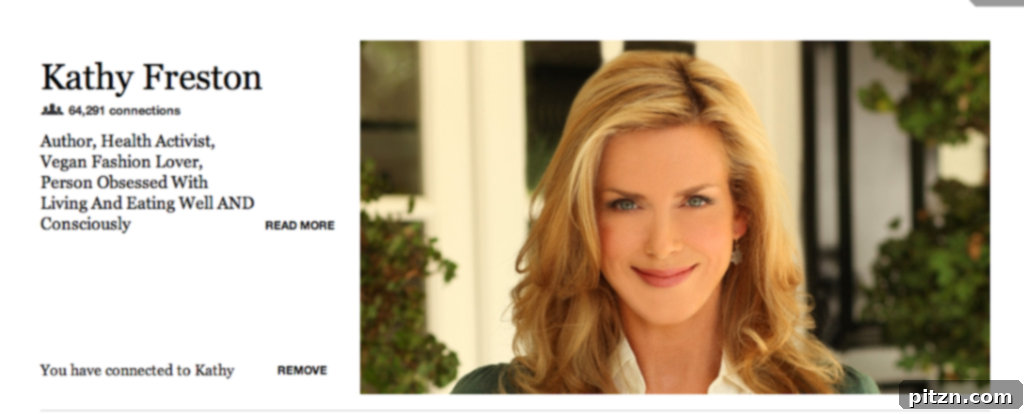
Transform Your Health: An Exclusive Interview with Bestselling Author Kathy Freston on “The Lean” and Plant-Based Living
In the realm of healthy eating and conscious living, few voices resonate as powerfully as that of **Kathy Freston**. An acclaimed bestselling author, Freston has dedicated her career to guiding individuals toward more vibrant, fulfilling lives through informed dietary and lifestyle choices. Her influence extends far beyond the pages of her books, reaching millions through frequent national television appearances and engaging online platforms.
Meet Kathy Freston: A Leading Voice in Wellness
Kathy Freston is a name synonymous with accessible, impactful wellness advice. Her literary contributions, including instant New York Times bestsellers like Veganist, Quantum Wellness, and The One, have empowered countless readers to embrace healthier habits. Freston’s ability to simplify complex nutritional science and present it in an engaging, actionable format has earned her a prominent place in the wellness community. She is a familiar face on major television programs, having appeared on shows such as Oprah, The Dr. Oz Show, and Ellen, where she masterfully distills her wisdom for a broad audience. Her capacity to connect with diverse groups and offer appealing, science-backed solutions is truly remarkable.
Recognizing her profound impact, VegNews Magazine honored Kathy Freston as their **2011 Person of the Year**. Beyond her books and TV appearances, Freston consistently shares her insights and expertise as a regular contributor to The Huffington Post, offering readers ongoing guidance on health and lifestyle topics.
Introducing “The Lean”: A Revolutionary Approach to Weight Loss
Kathy Freston’s latest masterpiece, The Lean: A Revolutionary (and Simple!) 30-Day Plan for Healthy, Lasting Weight Loss, offers a fresh perspective on achieving and maintaining a healthy weight. This groundbreaking book introduces readers to the concept of “leaning in” — a gentle yet highly effective methodology for incorporating small, impactful dietary and lifestyle adjustments that lead to sustainable results. Instead of focusing on deprivation, “The Lean” emphasizes abundance and positive changes, guiding individuals toward a healthier relationship with food and their bodies. You can explore a visual overview of the book and find shareable resources on her official website.
An Exclusive Opportunity: Our Interview with Kathy Freston via OpenSky
We recently had the distinct pleasure of conducting an insightful interview with Kathy Freston, facilitated by OpenSky. For those unfamiliar, OpenSky is an innovative social shopping network where leading experts and trendsetters across various fields—including health, food, style, and design—curate and share their invaluable advice, tips, and favorite products. This platform creates a unique space for consumers to discover trusted recommendations directly from the people who embody expertise and good taste.
You can delve deeper into Kathy Freston’s wealth of health tips and lifestyle suggestions by visiting her OpenSky profile. As a special treat, Kathy is offering signed copies of her book, The Lean, exclusively through OpenSky, starting today, March 27th! For the latest updates, promotions, and community interactions, be sure to track all the exciting happenings on the OpenSky Facebook Page.
We extend our sincerest gratitude to Kathy Freston and OpenSky for making this illuminating interview possible and for their commitment to empowering individuals on their health journeys. This week, we’re celebrating with exciting giveaways!
Enter to Win: A Copy of “The Lean”!
In the spirit of sharing wellness, OpenSky is generously offering a copy of The Lean to one fortunate reader! Don’t miss your chance to win this transformative guide. The giveaway closes on Saturday, March 31st, at midnight PST. Here’s how to enter:
How to Enter:
-
Mandatory Entry: Leave a comment on this post and provide a reliable way for us to contact you (e.g., email address or blog link). If you’ve previously read Kathy Freston’s books, we’d love to hear about your experiences and insights in your comment!
Additional Entries (Increase Your Chances!):
-
Like our blog on Facebook or share this giveaway on your Facebook or Twitter profile, then leave a separate comment on this post indicating you’ve done so.
-
Follow us on Pinterest, and leave another comment on this post to let us know.
-
Like OpenSky on Facebook, and submit a final comment on this post confirming your like.
An In-Depth Conversation: The Kathy Freston Interview
It was truly an honor to delve into Kathy Freston’s insights regarding healthy living and her latest book. Here’s what she shared:
“Hi Richa, So great to meet you, and very cool that you are spreading the word… bravo you! Here you go, the answers to your questions! Sending warmest your way!”
1. How did the idea for “The Lean” book come about?
Kathy explained, “I kept seeing really lovely people struggle mightily with their weight, and it broke my heart. People shouldn’t have to suffer like they do. They should be able to enjoy their lives AND enjoy good health and self-esteem. So I wanted to come up with a plan that would make weight loss easy and doable, something effective and science-based.” This deep empathy for people’s struggles with weight and her desire to offer a compassionate, evidence-backed solution fueled the creation of “The Lean.” She envisioned a plan that would genuinely empower individuals, rather than leaving them feeling defeated by conventional dieting methods.
2. What is “The Lean” about, and how is this plan different from the usual diets on the market?
Freston highlighted two key differentiators for “The Lean.” Firstly, she noted, “Most diets would have you cutting things out from your diet; they are about deprivation and discipline. ‘The Lean’ is focused on ‘crowding out,’ which means you are going to ADD things into your daily routine, thus leaving little room for the bad stuff. You won’t have to white-knuckle your way through it; you’ll just gradually not have the belly space to fit the old foods you are used to!” This “crowding out” strategy is a positive and empowering shift from the restrictive mentality common in dieting. Secondly, she added, “Most popular diets are animal protein based; ‘The Lean’ will have you gradually moving away from animal food and more into delicious whole grains, black beans and lentils and the like, fruits and veggies, and all kinds of wonderful alternatives to meat and dairy.” This gentle transition towards a plant-based diet offers immense health benefits without the shock of an abrupt change.
3. What should someone expect at the end of the 30 days and after?
“The way you eat and feel is going to totally shift (but it will happen gradually, with ease),” Kathy promised. “The cravings you have are going to change. Your body’s chemistry is going to adjust in a way that makes your physical transformation happen easily. The weight will be dropping off, and your health will turn around. You’ll also have clearer skin, better digestion, and tons of energy!” This comprehensive outcome underscores the holistic benefits of “The Lean,” moving beyond mere weight loss to encompass overall well-being, improved bodily functions, and a renewed sense of vitality.
4. Would you share an example of a breakfast and lunch for someone following the book?
Kathy provided delightful and practical examples: “For breakfast, you might enjoy a bowl of brown rice (I make a big pot of it twice a week and keep it in the fridge) with chopped dates and raw almonds, with agave and warmed soy or rice milk poured atop. Oatmeal is certainly great too; I just like to change it up with different grains. If you are on the run, you can have whole-grain toast and peanut butter. For lunch, you could enjoy a black bean burrito with salsa and avocados along with a salad or some quinoa with veggies and chickpeas along with a thick butternut squash soup. There are 40 recipes and lots of meal plans to choose from!” She also recommended a Soy Milk Maker, highlighting its versatility for creating fresh plant milks, porridges, and pureed soups.
5. What is the main problem with usual dieting techniques, be it cutting down on certain things, talking about moderation, carb counting, or more protein?
Freston critically analyzed common diet pitfalls: “Granted, you will probably lose weight on a high-protein, low-carb diet. But the weight loss comes partly from eating fewer calories, because you are knocking out so much of what you normally would consume, and partly because these days eliminating carbohydrates means doing away with calorie-dense, highly processed foods (most of which contain HFCS).” She clarified, “Of course you lose weight when you give up cookies and cakes and doughnuts, which erroneously get lumped together with good carbs like those from brown rice and quinoa. But eating a high-protein, low-carb diet doesn’t work long term (most people gain it all back and then an extra 5%!). Not only that, it wreaks serious damage to your kidneys and heart.” This explanation debunks the myth of effective long-term weight loss from restrictive, unhealthy diets, emphasizing their potential for rebound weight gain and severe health consequences.
6. Why do you think this plan will work in the long run?
Kathy asserted, “‘The Lean’ works long term because you will feel FULL AND SATISFIED. No white-knuckling. It’s all about the fiber (in whole grains, beans, nuts, seeds, fruits, etc.) – fiber is the one dietary component that has consistently been the key factor in lasting weight loss. It fills you up, stabilizes your blood sugar, cleans out the fat, and lowers your cholesterol.” This answer zeroes in on the often-underestimated power of fiber, explaining how it naturally promotes satiety and contributes to comprehensive metabolic health, making the plan sustainable and enjoyable indefinitely.
7. What would you tell someone wanting to do things in moderation or wanting other substitutes rather than vegan options?
Kathy distinguished between “leaning in” and moderation: “‘Leaning in’ is very different than moderation. ‘Leaning in’ means you set your intention to go in the direction of health, and you take small, interconnected steps in that direction. A momentum builds, and before you know it, you are dropping pounds. Moderation, on the other hand, means you try and reduce the amount of something you know is bad for you. I like to keep things positive – adding things in, rather than taking things away!” This mindset shift from restriction to positive addition is a cornerstone of “The Lean,” encouraging a proactive approach to health rather than a reactive one.
8. What about eating out and entertaining people while you are following the plan or after?
Freston offered practical and enthusiastic advice: “I like to think of eating out as a sport! I love finding restaurants that have good healthy options, like Mexican (black bean tostadas) or Thai (tofu curry) or Greek (hummus and salads). I also check HappyCow.org to see where there are good options in whatever town I’m headed to. If I go to someone’s house, I bring a favorite dish along with me to make it easy on the host; inevitably the other guests always want to try what I have. I love being an ambassador for eating well, because most people these days are super interested in either slimming down or getting more energy!” Her perspective transforms potential challenges into opportunities for discovery and advocacy, showing that healthy eating can be both enjoyable and social.
9. Soy has lots of controversies around it, positive or negative, and not necessarily all true. Why is there a lot of focus on soy during the transition, and is there a way to find other options?
Addressing the soy debate, Kathy clarified, “The science is pretty strong in support of the healthfulness of soy (it’s high in protein and fiber), but it certainly isn’t necessary if you don’t like it. Other excellent sources of protein are quinoa, any kind of bean or legume, seitan (wheat protein), nuts, and seeds. I stress including plant protein at every meal because the science shows that protein makes you feel satiated. And being satiated is important so that cravings and hunger don’t get the best of you! You just want to be sure it’s clean protein, not the fatty, cholesterol-laden protein from animals.” This balanced view reassures readers about soy’s benefits while offering a wide array of alternative plant-based protein sources, reinforcing the importance of protein for satiety and differentiating between clean plant protein and animal protein.
10. Similarly, why so many processed food options during the transition? Isn’t it like jumping from one bad wagon to the other in terms of health?
Kathy defended the use of transitional foods: “Oh no; transitional foods are wonderful! Veggie sausage may be ‘processed,’ but it’s minimally so. And it’s far lower in fat and calories than the ‘real’ stuff, with zero cholesterol. As an important aside, no animals were harmed in the making of it! It’s a good step in the right direction. For the vast majority of people, moving from steak and chicken to a bowl of rice and beans is just not going to happen, so meat alternatives are an excellent way to ‘crowd out’ the really harmful stuff. It’s all about progress, not perfection!” She emphasized that these alternatives serve as crucial bridges for individuals moving away from traditional diets, enabling gradual, sustainable change rather than an unrealistic, immediate overhaul.
11. Would you recommend this book to nursing mothers who are trying to lose pregnancy weight or other age groups like children and seniors?
Freston confidently affirmed the plan’s universality: “‘The Lean’ is medically sound for any and all age groups; in fact, it’s far healthier than the Standard American Diet. It has the endorsements of Dr. Andrew Weil, Dr. Dean Ornish, and Dr. Neal Barnard, so anyone should feel very safe in doing it. You couldn’t say that for diets like Atkins.” This strong endorsement from renowned medical experts highlights the safety and nutritional completeness of “The Lean” for diverse populations, from growing children and nursing mothers to active seniors.
12. On a topic not related to weight loss, in general, what advice would you give to people recuperating from major illnesses like cancer? About a vegan diet, changes, and additions to their meal plan for a healthier life ahead.
For those recuperating, Kathy’s advice was clear and concise: “The more fiber-rich, nutrient-dense food you eat, and the more you stay away from meat and dairy, the better your health will thrive.” This powerful statement underscores the profound healing potential of a whole-food, plant-based diet, rich in protective nutrients and free from inflammatory animal products, making it an ideal approach for recovery and long-term health maintenance.
13. I come from a vegetarian background, as most Indians do. A good Indian diet is usually balanced and not too high in dairy, and hence it is always a tough task to convince anyone into cutting dairy out if they are already consuming limited amounts of dairy. What would you say about replacing dairy completely from the daily diet?
Addressing the cultural aspect of dairy consumption, Kathy offered a compelling perspective: “Cow milk is perfectly designed by nature to make a little tiny calf put on 1000 pounds super quickly. The calf will grow to be fat, docile, and slow. We don’t want to be fat, docile, and slow; we want to be lean and quick on our feet! Plus, the main reason we would drink milk is for the calcium, but many of the nondairy milks on the market have 50% more calcium than dairy milk anyway, so why wouldn’t you opt for them?” This analogy effectively illustrates the biological purpose of cow’s milk for calves, not humans, and provides a clear, practical reason (superior calcium content in fortified plant milks) for making the switch.
14. What are some of the amazing stories or events that have happened recently because someone made some changes because of you or your books?
Kathy shared heartwarming success stories: “People tell me their lives are completely changed after they have ‘leaned in.’ One guy lost 100 pounds, another gal lost 200. It’s really wonderful to see!” These inspiring transformations underscore the real-world impact of her work, demonstrating that significant, life-altering health improvements are achievable through her gentle yet powerful methodology.
15. Message to the readers of the blog and everyone.
Kathy’s final message was one of encouragement and simplicity: “Just set your intention to lose weight, nudge yourself forward a little, and then keep leaning!” It’s a call to action that emphasizes gradual progress and consistent positive effort, rather than overwhelming perfection.
Connect with Kathy Freston
To learn more about Kathy Freston’s work, connect with her on social media, and continue your journey towards a healthier, more conscious life, please visit:
- Website
- Kathy on OpenSky